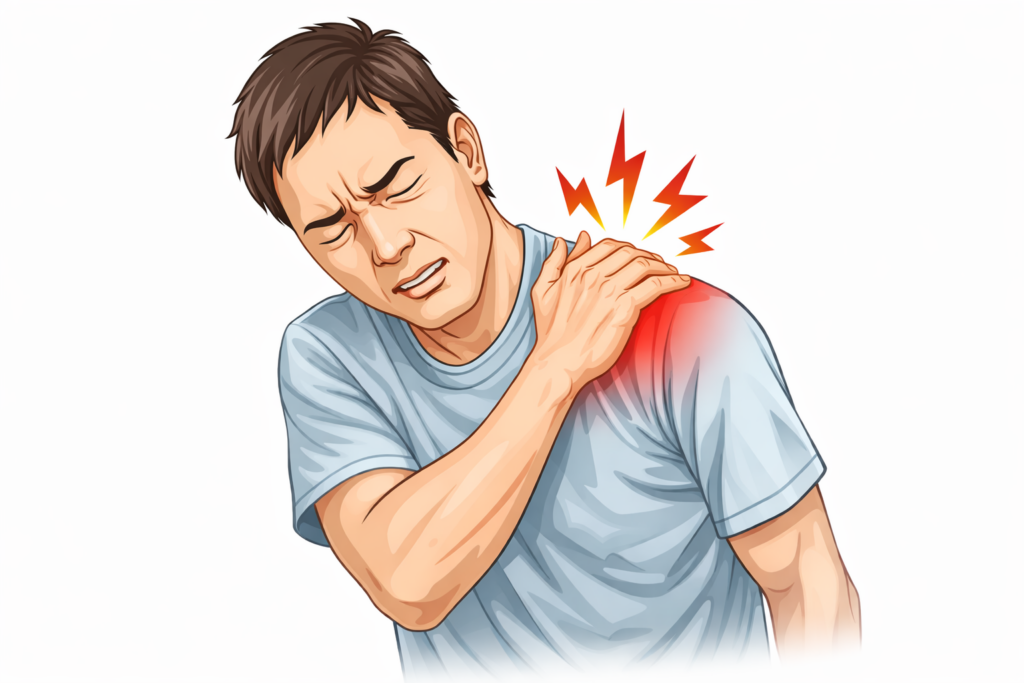
“My shoulder hurts — what could be wrong?”
In daily clinical practice, I see patients of all ages coming in with shoulder pain.
“Is this frozen shoulder?”
“Another clinic told me I have a rotator cuff tear. Do I really need surgery?”
“Should I get an MRI?”
Shoulder pain can have many different causes, and
based on symptoms alone, it is often difficult to identify the exact problem.
In this article, I’ll walk you through
the most common causes of shoulder pain,
their key characteristics,
when imaging studies are considered,
and how treatment is typically approached — step by step.
Why does shoulder pain have so many different causes?
The shoulder is the most mobile joint in the human body.
Because of its wide range of motion and complex anatomy,
even minor structural problems can lead to pain.
Based on the structures involved, shoulder pain can generally be classified into four major categories:
- Tendon-related problems (rotator cuff)
- Joint capsule problems
- Bone shape–related impingement
- Other causes such as calcification, inflammation, or trauma
Let’s take a closer look at each one.
If you are looking for more detailed answers to common shoulder concerns,
the following articles may be helpful:
👉Rotator cuff tear treatment without surgery
👉Shoulder impingement and bone overgrowth
👉Calcium deposits in the shoulder
1. Rotator Cuff Disorders (Most Common Cause)
Rotator cuff disorders are the most common cause of shoulder pain,
most frequently occurring in people in their 50s and 60s due to degenerative changes.
● What is the rotator cuff?
The rotator cuff consists of four tendons that stabilize and move the shoulder joint:
- Supraspinatus
- Infraspinatus
- Subscapularis
- Teres minor
Together, they help lift and rotate the arm while keeping the shoulder stable.
● Common symptoms
- Pain when lifting or rotating the arm
- Sharp pain at certain angles
- Limited range of motion due to pain
● Common conditions
- Rotator cuff tendinitis
- Rotator cuff tear (partial or full-thickness)
Many patients worry that a rotator cuff tear automatically means surgery.
However, depending on tear size and symptoms,
there may be treatment options for rotator cuff tears without surgery.
The supraspinatus tendon is most commonly involved,
and in some cases, the subscapularis tendon may also be affected.
With a complete tear, lifting the arm can become very difficult.
● Imaging studies
- Ultrasound
Can be performed immediately in the clinic.
It allows dynamic evaluation while the patient moves the arm and can guide injections if needed. - MRI
Provides the most accurate assessment of tear size and muscle degeneration.
● Treatment
- Tendinitis
Often improves with medication and corticosteroid injections.
Because injections are commonly used,
patients often ask whether shoulder injections are safe
and when they are appropriate.
- Partial tears
Treatment depends on tear size and patient factors such as age and activity level.
Small tears may be managed conservatively, while larger tears may require arthroscopic repair. - Full-thickness tears
Most are treated with arthroscopic repair.
In cases of massive tears with severe muscle degeneration, tendon augmentation or even shoulder replacement may be considered.
Treatment decisions are based on imaging findings and the patient’s symptoms, activity level, and overall health.
A thorough discussion with a specialist is essential.
I have also seen patients with full-thickness rotator cuff tears and significantly weakened cuff muscles who still maintained good shoulder motion and only mild pain.
In some of these cases, surrounding muscles — especially the deltoid — compensate over time, allowing relatively comfortable movement despite the tear.
These patients did not require surgery and were managed with simple pain medication.
This highlights an important point:
Treatment decisions should be based primarily on pain level and functional limitation in daily life — not imaging findings alone.
Not every abnormal scan result means surgery is necessary.
2. Frozen Shoulder (Adhesive Capsulitis)
Frozen shoulder is one of the most well-known causes of shoulder pain,
typically affecting people between their 40s and 60s.
● Key features
- Pain even at rest
- Worse pain at night
- Global limitation of shoulder motion
- Progressive stiffness over time
● Important points
- Early stage: Pain is the main symptom
- Later stages: Stiffness and limited motion become more prominent
- Symptoms may resemble rotator cuff disorders, making diagnosis challenging
● Imaging studies
- MRI is not routinely required at the initial stage
but may be considered if symptoms do not improve with standard treatment
or if the clinical course is atypical.
● Treatment
- Most patients improve with corticosteroid injections and guided home exercises.
- If pain and stiffness persist despite conservative treatment,
arthroscopic surgery may be considered to release the tightened joint capsule.
In some cases, procedures to release a stiff joint capsule may be performed to improve mobility.
However, these procedures must be done carefully.
There have been instances in clinical practice where excessive force during manipulation resulted in complications such as fractures.
For this reason, capsular release is typically performed under proper anesthesia,
when muscles are fully relaxed.
Even then, restoring motion should be done gradually and carefully to avoid injury.
3. Shoulder Impingement Syndrome
This condition occurs when the rotator cuff tendons are repeatedly compressed under the acromion during arm elevation, leading to inflammation and pain.
The acromion is a bony structure above the rotator cuff that acts like a “roof” over the tendons.
Patients are often told they have impingement caused by an overgrown bone,
which can be confusing and concerning.
Understanding what shoulder impingement and acromial bone changes really mean
can help guide proper treatment decisions.
● When to suspect impingement
- Pain only at certain angles (usually between 60–120 degrees)
- Less pain when the arm is fully raised
- Repetitive overhead activity
● Imaging studies
- X-ray
Evaluates the shape of the acromion, which can increase tendon compression. - MRI
Helps assess inflammation and associated rotator cuff tears.
● Treatment
- Many patients respond well to medication and corticosteroid injections.
- If symptoms persist or tendon damage progresses,
arthroscopic surgery may be performed to remove inflamed tissue and reshape the bone.
4. Calcific Tendinitis
Calcific tendinitis occurs when calcium deposits form within the rotator cuff tendons.
As these deposits are reabsorbed, they can trigger a strong inflammatory reaction, causing severe pain and limited motion.
Because calcium deposits can cause severe pain,
many patients worry that surgery is unavoidable.
In reality, calcium in the shoulder does not always require surgery.
● Typical features
- Sudden onset of intense pain
- Significant restriction of shoulder movement
- Severe night pain
● Imaging studies
- X-ray
Best initial test to detect calcium deposits. - Ultrasound
Precisely locates the deposit and can guide needle procedures. - MRI
Useful when evaluating associated rotator cuff tears.
● Treatment
- Pain control with medication and injections
- Ultrasound-guided needling or extracorporeal shock wave therapy
- Arthroscopic removal may be considered if the tendon is significantly compromised
After calcium deposits are removed in calcific tendinitis,
consistent range-of-motion exercises are very important.
I have seen patients who did not continue their rehabilitation exercises after calcium removal and later developed adhesive capsulitis (frozen shoulder).
After receiving injection therapy and guided rehabilitation, they eventually recovered.
Because pain often leads patients to limit shoulder movement,
the joint can become stiff if it is not moved regularly.
For this reason, following the range-of-motion exercises recommended by your doctor is essential.
5. Shoulder Arthritis and Other Causes
- Degenerative shoulder arthritis
- Post-traumatic pain
- Referred pain from cervical spine disorders
- Rarely, infection or tumors
● Not all shoulder pain originates from the shoulder itself.
A Final Message From The Clinic
Not all shoulder pain is the same.
Depending on the cause:
- Treatment methods differ
- Recovery timelines vary
- The need for imaging or surgery can change significantly
Rather than self-diagnosing,
a proper medical evaluation can help determine the true cause and the most appropriate treatment.
I hope this guide helps you better understand why shoulder pain occurs
and how it is typically evaluated and treated.
Leave a Reply