What Does That Mean? Do I Need Surgery?
In daily clinical practice, many patients come in with shoulder pain and ask similar questions after reviewing their imaging results.
“They said the bone looks overgrown on my X-ray.”
“I was told the tendon is being compressed by bone—what does that mean?”
“Does this mean I need surgery?”
While these explanations are familiar to physicians,
they can sound vague and concerning from a patient’s perspective.
In this article, I’ll explain
what shoulder impingement syndrome is,
what doctors mean when they say a bone is ‘overgrown’,
and when surgery may or may not be considered—in a clear and practical way.
What is shoulder impingement syndrome?
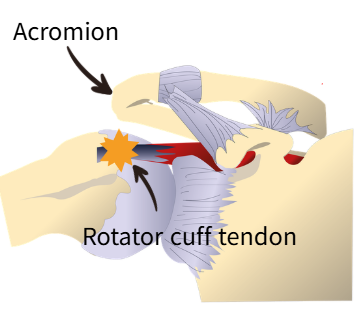
Shoulder impingement syndrome refers to a condition in which
the rotator cuff tendon is repeatedly compressed against the acromion,
a bony structure at the top of the shoulder, during arm elevation.
As you lift your arm, the rotator cuff tendon passes through a narrow space beneath this bone.
If that space becomes too tight, the tendon can be repeatedly irritated.
As a result:
- Inflammation can develop in the tendon
- Pain may occur at specific angles of movement
- Shoulder discomfort can worsen with repeated use
This group of symptoms is collectively referred to as shoulder impingement syndrome.
What does “overgrown bone” actually mean?
Hearing this term often leads to understandable concerns, such as:
“Is my bone still growing?”
“Will the tendon eventually tear because of the bone?”
In most cases, the answer is no.
When doctors say a bone looks “overgrown,”
it usually does not indicate a dangerous condition.
Above the rotator cuff tendon lies the acromion, which acts like a roof over the shoulder.
The shape of this bone naturally varies from person to person.
With aging or long-term shoulder use:
- The edge of the bone may become slightly prominent
- Or the underside may curve downward
These shape changes can reduce the space available for the tendon,
making compression more likely when the arm is raised.
This is what is typically meant by the phrase
“the bone is overgrown.”
Does shoulder impingement automatically mean surgery?
The short answer is no.
Even if shoulder impingement is present,
surgery is not required in most cases.
Treatment decisions are based on several factors, including:
- The severity of pain
- How much shoulder function is affected
- Whether symptoms improve with medication or injections
Many cases improve without surgery
In situations like the following,
conservative treatment is often sufficient:
- Pain is mild or intermittent
- Daily activities are still manageable
- Symptoms respond to medication or injections
In these cases, improvement is commonly achieved through:
- Anti-inflammatory medication
- Injection therapy
- Activity modification
- Shoulder stretching and rehabilitation exercises
As part of activity modification, some patients choose to
use a shoulder support brace
to reduce mechanical stress during daily movements.
Examples of commonly used shoulder braces, such as the
Fightech shoulder brace, can be found here.
When is surgery considered?
Surgical treatment may be discussed if:
- Pain persists despite adequate conservative treatment
- Shoulder use becomes significantly limited in daily life
- Progressive rotator cuff damage or tearing is identified
The goal of surgery in these cases is to:
- Smooth a small portion of the prominent bone
- Remove inflamed tissue
- Increase the space for the tendon to move freely
Most procedures are performed arthroscopically,
and recovery is often faster than patients expect.
A common misconception
“If the bone is the problem, isn’t surgery the only solution?”
Not necessarily.
Even with similar imaging findings:
- Some patients do well without surgery
- Others may eventually require treatment
What matters most is not the appearance of the bone alone,
but the patient’s symptoms, tendon condition, and functional limitations.
Even if X-rays show significant bony prominence,
surgery is often unnecessary if pain is controlled, tendon integrity is preserved,
and shoulder function remains acceptable.
A final message from the clinic
Being told that you have
“shoulder impingement” or
“an overgrown bone”
does not mean you should panic.
Treatment decisions are best guided by:
- The level of pain
- Limitations in shoulder movement
- Response to medication or injection therapy
Rather than self-diagnosing based on imaging alone,
a proper clinical evaluation can help determine the most appropriate course of care.
Shoulder impingement is just one of many possible causes of shoulder pain.
To better understand how impingement fits into the broader picture,
see our overview of shoulder pain.
Leave a Reply