Understanding Treatment Options
After experiencing knee pain and swelling, many patients undergo an MRI at another clinic and are told that their meniscus is torn.
Hearing that diagnosis often brings immediate concern.
“Does this mean I need surgery?”
“Will my knee get worse if I leave it untreated?”
“I heard a torn meniscus can lead to arthritis — should I be worried?”
These concerns are completely understandable.
However, the most important thing to know is this:
● Not all meniscus tears are serious, and not all require surgery.
What Is the Meniscus?
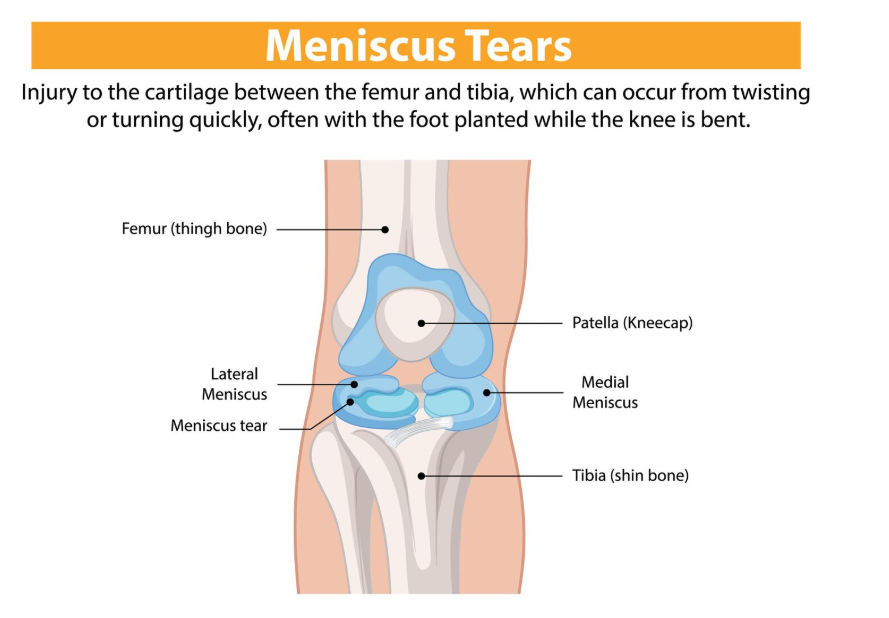
The meniscus is a crescent-shaped piece of fibrocartilage located inside the knee joint, between the femur (thigh bone) and tibia (shin bone).
Each knee has two menisci that play essential roles in:
- Absorbing shock
- Distributing body weight evenly
- Maintaining joint stability
When the meniscus is damaged, repetitive loading during walking or running can increase stress within the knee, often leading to pain and swelling.
Why Does the Meniscus Tear?
Meniscus tears generally occur in two main ways.
① Traumatic injury
- Twisting the knee during sports
- Sudden pivoting movements
- Rising from a deep squat
These injuries are more commonly seen in younger and physically active individuals.
② Degenerative changes
In middle-aged and older adults, meniscus tears may occur even without a clear injury.
Over time:
- The meniscus gradually weakens
- Normal daily movements can cause small tears
This type is known as a degenerative meniscus tear.
Is a Torn Meniscus Always a Major Problem?
Not necessarily.
MRI studies often reveal meniscus tears even in people who have little or no knee pain.
This is especially common in patients in their 50s and 60s, where the tear reflects age-related degeneration rather than the primary cause of pain.
In these cases, surgical repair is unlikely to restore the meniscus, and conservative treatment is usually sufficient.
On the other hand, in younger patients who develop knee pain after a specific injury, MRI findings may reveal a tear pattern that requires different consideration.
Depending on the location and configuration of the tear, surgical treatment may sometimes be appropriate.
Common Symptoms of a Meniscus Tear
Symptoms may include:
- Pain along the joint line
- Swelling after activity
- Catching or clicking sensations
- Difficulty fully bending or straightening the knee
When these symptoms persist, evaluation by an orthopedic specialist is recommended.
How Is a Meniscus Tear Treated?
① When surgery may be considered
Surgical treatment is more likely to be discussed when:
- Pain persists despite adequate conservative care
- The knee repeatedly catches or locks
- Daily activities are significantly limited
- The patient is relatively young and physically active
Treatment decisions are based on:
- Tear location
- Tear pattern and size
- Patient age and activity level
The outer portion of the meniscus has better blood supply, allowing healing after repair.
In contrast, tears located toward the inner portion often have limited healing potential.
In younger patients, early loss of meniscal function may increase the risk of cartilage damage and future osteoarthritis, which is why meniscus preservation is prioritized whenever possible.
② When non-surgical treatment is appropriate
Many patients improve without surgery, especially when:
- Pain is mild
- There is no true mechanical locking
- Daily function is largely preserved
- The patient is older
Non-surgical treatment may include:
- Activity modification and medication
- Physical therapy and muscle strengthening
These approaches are often effective.
However, even in older patients, tear pattern and location may occasionally require surgical consideration, emphasizing the importance of individualized evaluation.
A meniscus tear is only one of several possible sources of knee pain.
If you’d like to see how meniscus injuries compare with other common knee conditions, this overview may be helpful:
👉 My Knee Hurts — What Could Be the Problem?
A Message I Often Share With Patients
Being told that your meniscus is torn can be frightening.
But the word “torn” does not automatically mean surgery is necessary.
Treatment decisions are not based on MRI findings alone.
Instead, doctors consider:
- Your current pain level
- How your knee functions in daily life
- The location and pattern of the tear on MRI
- Your age and activity demands
In some younger patients, MRI findings play an important role in determining whether early surgical treatment may help preserve meniscal function.
For others, careful monitoring and conservative care may be all that is needed.
The most important step is discussing your individual situation with an orthopedic specialist to determine the most appropriate treatment plan for you.
Leave a Reply