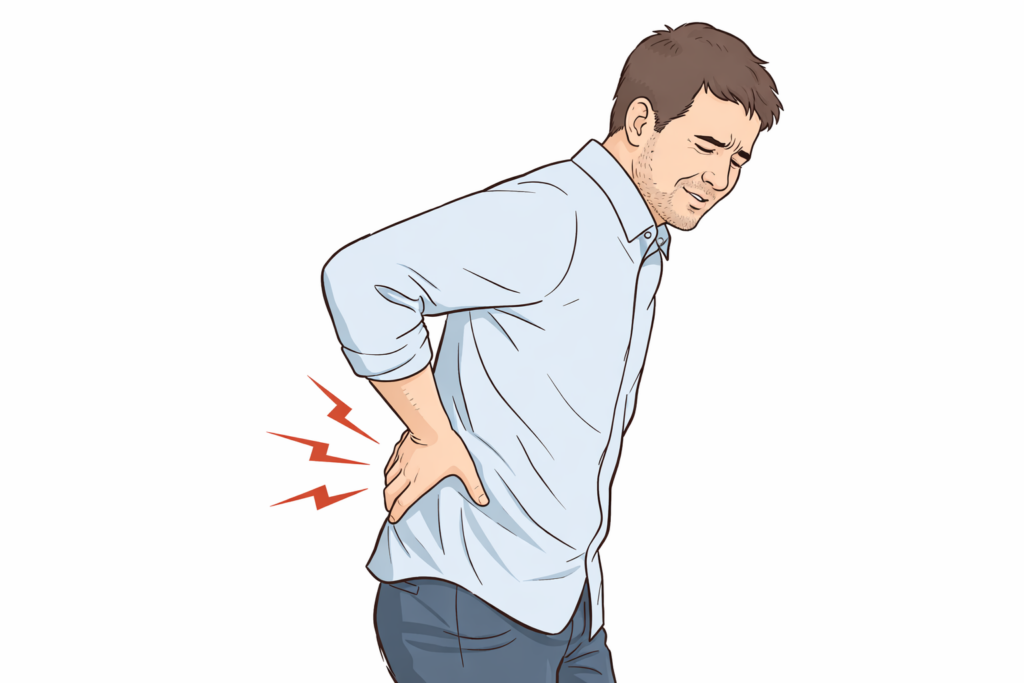
In clinical practice, back pain is one of the most common reasons patients visit an orthopedic clinic.
Many patients ask questions such as:
“Is this a disc problem?”
“Do I need an MRI?”
When back pain occurs, it is common to hear from others that it “might be a disc issue,” which can understandably lead to anxiety and a hospital visit.
However, not all back pain is caused by a disc problem, and advanced imaging is not always necessary.
In this article, we will review:
- Common causes of back pain
- When imaging studies are considered
- How back pain is typically treated
in a clear and practical way.
Why Does Back Pain Occur?
Back pain rarely has a single cause.
In most cases, multiple factors contribute to symptoms.
1. Muscle and Ligament Strain
This is the most common cause of back pain.
It often occurs after:
- Lifting heavy objects
- Sudden twisting or bending movements
- Prolonged sitting or poor posture
In these situations, the muscles and ligaments supporting the spine become overloaded, leading to pain.
Many patients worry that pain after exercise means a serious disc injury.
However, most cases are related to muscle strain rather than
disc herniation after working out.
Most cases improve gradually with:
- Rest
- Medications
- Physical therapy
without the need for further intervention.
2. Disc-Related Problems
A lumbar disc herniation occurs when a disc between the vertebrae protrudes and compresses nearby nerves.
Many patients wonder whether a disc problem
can resolve without surgery and whether a herniated disc can heal on its own.
In addition to localized back pain, patients may experience:
- Pain radiating to the buttock
- Thigh or calf pain
- Numbness or tingling in the leg
Disc-related problems can also occur in the cervical spine,
and recognizing the early signs of cervical disc herniation
is important when neck pain or arm symptoms are present.
3. Degenerative Changes and Joint Issues
As we age, degenerative changes can occur in the spinal discs and facet joints.
These changes may cause:
- Chronic or recurrent back pain
- Pain that worsens with certain positions or movements
How Is Simple Back Pain Different from Disc-Related Pain?
Distinguishing between these two is an important part of evaluating back pain.
Features of Simple Mechanical Back Pain
- Pain localized to the lower back
- No pain radiating down the leg
- Symptoms often improve with rest or medication
Features of Disc-Related Pain
- Back pain accompanied by leg pain
- Possible numbness, sensory changes, or weakness
The pattern of pain and associated symptoms helps guide diagnosis and management.
When Is Imaging Necessary for Back Pain?
Imaging studies are not required for all cases of back pain.
However, imaging can be helpful in the following situations:
■ Persistent or Worsening Pain
- Pain that does not improve despite rest
- Pain that gradually becomes more severe
■ Neurologic Symptoms Radiating to the Leg
- Leg numbness
- Sensory changes
- A feeling of weakness
In these cases, MRI may be considered to evaluate possible nerve compression.
■ Back Pain After Trauma
- Falls or direct impact
- Suspicion of fracture
In such situations, X-ray or CT imaging may be useful.
Back pain after trauma, especially in older adults, raises concern
for serious conditions such as a spinal fracture in older adults,
where prompt imaging is essential.
How Is Back Pain Treated?
Many people worry that back pain automatically means surgery.
Fortunately, most cases of back pain improve without surgery.
Conservative Treatment Is the First Approach
- Medications
- Physical therapy
- Exercise therapy
- Injection treatments
-Injection treatments are sometimes considered when pain does not improve with medications or physical therapy, and understanding when a back injection is recommended
can help guide appropriate treatment decisions.
- Posture and lifestyle modification
Surgery is considered only in limited situations, such as:
- Progressive neurologic weakness
- Bowel or bladder dysfunction
- Severe pain that does not respond to conservative treatment
A final message from the clinic
Having back pain does not necessarily mean there is a serious problem.
However, if:
- Pain persists or becomes severe
- Neurologic symptoms develop in the leg
it is best to seek medical evaluation rather than making assumptions.
We hope this article has helped clarify
why back pain occurs and when imaging may be needed.
Leave a Reply