After twisting an ankle, many people start wondering whether they need to wear an ankle brace.
If an ankle ligament injury involves a partial or complete tear,
a brace is often necessary under medical guidance.
However, when the injury is limited to a minor or microscopic tear,
patients are often unsure:
“Do I really need a brace?”
“Can I walk without one?”
“How long should I keep wearing it?”
Medication may be prescribed,
but braces often feel optional and confusing.
In this article, focusing on mild ankle ligament injuries (Grade 1 sprains),
we’ll walk through:
- When an ankle brace is actually helpful
- How to choose the right type of brace
- How long it usually needs to be worn
—all from a practical, patient-centered perspective.
Do You Always Need an Ankle Brace?
The short answer is no.
✓ Not every ankle ligament injury requires a brace.
In many cases, a brace may be used only briefly—or not at all—if:
- Pain is very mild
- Walking is not significantly limited
- Swelling is minimal
- Symptoms improve rapidly within 1–2 days after the injury
In these situations,
overusing a brace may actually slow recovery.
Wearing a brace longer than necessary can reduce muscle activation
and delay proper rehabilitation.
For some patients,
walking and beginning gentle rehabilitation without a brace
can lead to a faster and more natural recovery.
When Is an Ankle Brace Helpful?
On the other hand, wearing a brace can be beneficial
if any of the following apply:
- Pain persists while walking
- The ankle feels unstable or “gives way”
- Swelling has not fully resolved
- There is fear of re-injury
- Daily activities or work require prolonged standing or walking
In these cases, a brace helps by
stabilizing the ankle and reducing the risk of re-injury.
Especially during the early recovery phase,
a brace can be very helpful when
“you can walk, but the ankle doesn’t feel quite reliable yet.”
How Should You Choose an Ankle Brace?
With so many ankle braces available,
choosing the right one can be confusing.
For mild ligament injuries (Grade 1 sprains),
most patients choose between two main types:
Compression sleeve–type braces
→ Suitable for mild pain and everyday walking
Strap-style ankle braces
→ Better when pain is more noticeable
→ Helpful if the ankle feels unstable
The most important factor is
how much pain and instability you personally feel.
- If pain or instability is more pronounced, starting with a strap-style brace can be helpful.
- If symptoms are mild, a simple compression sleeve is often sufficient.
That said,
strap-style braces provide more support but should not be worn longer than necessary,
as prolonged use may interfere with muscle recovery and rehabilitation.
✓ The key is choosing a brace that matches your current condition, not the strongest one available.
Recommended Ankle Brace Examples (For Reference Only)
The products below are provided as examples to help you understand brace types.
They are not specific medical recommendations, and the best choice may vary depending on individual symptoms and recovery stage.
Compression Sleeve–Type Ankle Brace
(For mild pain and everyday walking)
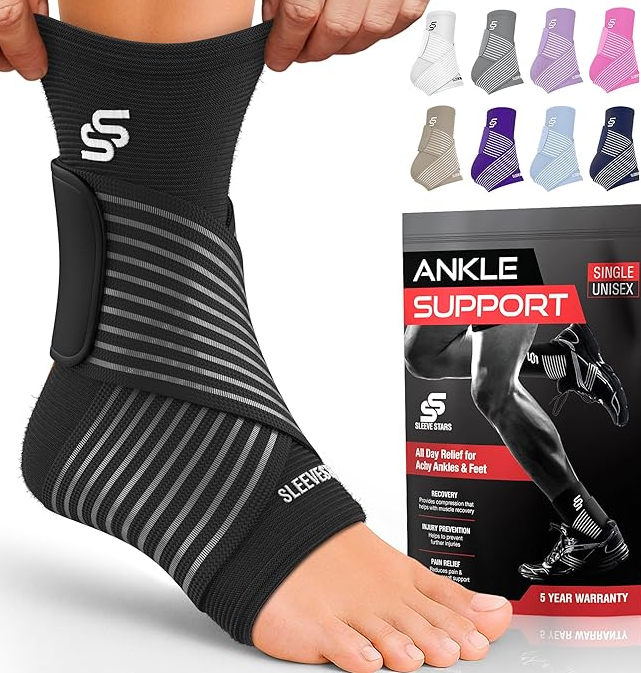
A compression sleeve–type ankle brace is often sufficient when pain is mild and walking is mostly comfortable.
Why this type is commonly chosen:
- Lightweight and easy to wear under shoes
- Provides gentle compression without restricting movement
- Popular among patients with Grade 1 ankle sprains
[View a popular compression sleeve ankle brace on Amazon]
Strap-Style Ankle Brace
(For instability or more noticeable pain)
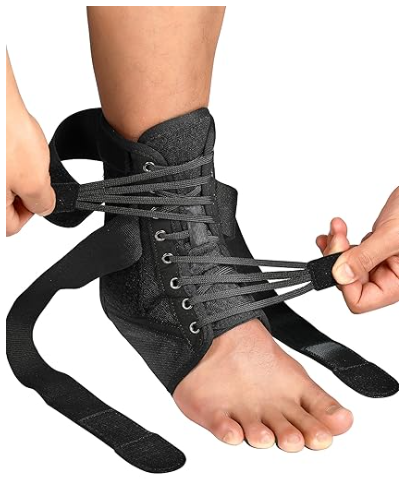
Strap-style ankle braces provide additional support by limiting excessive inward or outward ankle motion.
Why many patients prefer this type:
- Adjustable straps for customized support
- More stability than compression sleeves
- Frequently used when the ankle feels unstable or prone to giving way
[View a highly rated strap-style ankle brace on Amazon]
How to Use These Examples
- These products are shown to illustrate brace categories, not to promote a specific brand
- Higher support does not always mean better recovery
- Choose the brace that matches your current pain level and sense of stability
As symptoms improve, brace use should be reduced gradually, regardless of the type used.
Affiliate & Medical Disclaimer
Some links on this page may be affiliate links.
This does not affect the price you pay.
Products shown are for educational purposes only and are not a substitute for professional medical advice.
How Long Should You Wear an Ankle Brace?
In general,
most people wear an ankle brace for about 1–3 weeks.
However, the exact duration depends on
how quickly pain and swelling improve.
For example:
Even if you start with a strap-style brace,
you may switch to a compression sleeve
after 2–3 days once swelling decreases
and the ankle feels more stable.
If, after wearing a compression brace for several days,
you can walk comfortably with little to no pain,
you may not need to continue wearing a brace
for the full 1–3 weeks.
That said, if pain returns or you anticipate long periods of walking,
temporarily using the brace again is a sensible choice.
If pain remains significant after about 3 weeks,
the injury may be more than a mild sprain—
possibly a partial ligament tear or more.
In such cases,it’s best to consult an orthopedic specialist
rather than simply extending brace use on your own.
Why Is It Better to Gradually Reduce Brace Use?
Once pain improves,
it’s usually best to gradually reduce brace use,
even if 1–2 weeks have not fully passed.
Wearing a brace for too long may:
- Decrease muscle use around the ankle
- Delay recovery of balance and joint stability
- Make the ankle more sensitive to minor discomfort
As a general guideline,
brace use can be reduced as the following improve:
- Pain
- Swelling
- Sense of instability
Gradual reduction helps restore natural ankle function.
Key Takeaways
- An ankle brace is not required in every case
- It can be helpful when pain or instability persists
- Most people wear a brace for 1–3 weeks, depending on symptoms
- Brace use should be reduced gradually as recovery progresses
- A brace supports recovery—but prolonged use can slow rehabilitation
An ankle brace is neither something you must always wear
nor something that should be used indefinitely.
What matters most is using it
when it’s helpful, for as long as it’s needed—and no longer.
If your recovery feels uncertain or slower than expected,
a proper evaluation by an orthopedic specialist
is the safest way to determine the right course of treatment.
Leave a Reply