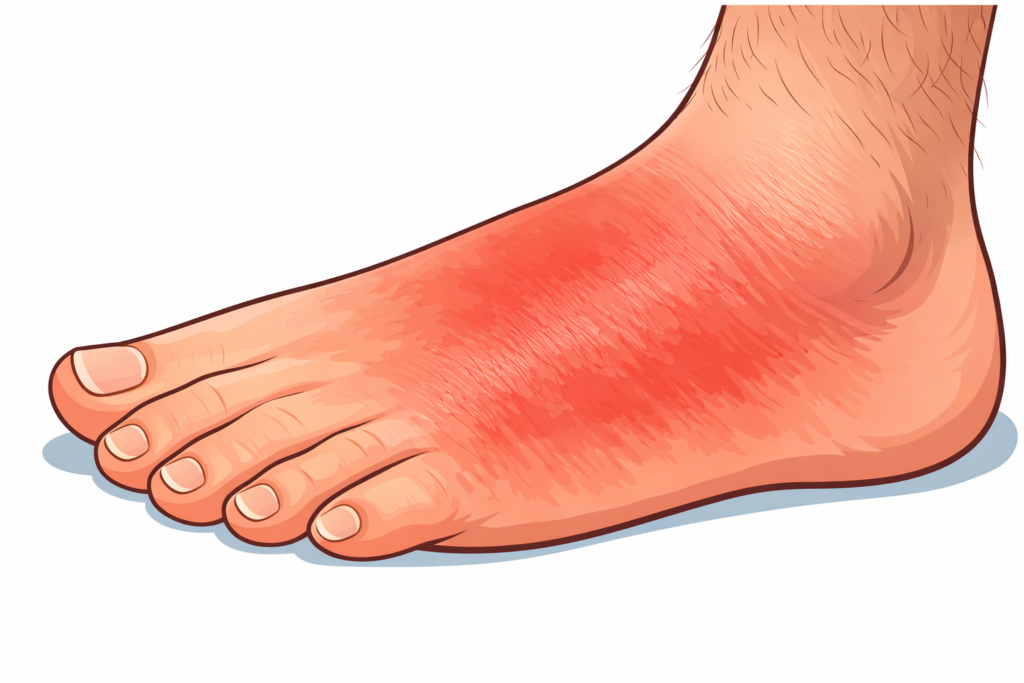
After an insect bite or a minor skin injury such as a small abrasion, some people notice that the area does not heal as expected. Instead, the top of the foot or the lower leg gradually becomes red, swollen, and increasingly painful.
When proper wound care and disinfection are neglected, even a small break in the skin can become an entry point for bacteria. Once bacteria spread beneath the skin, inflammation of the soft tissues can develop.
In the clinic, patients often describe their symptoms this way:
“My foot feels hot and burning.”
“It looks visibly red and swollen.”
“It hurts even when I’m not moving.”
These symptoms are commonly seen when infection affects the skin and the underlying soft tissue (subcutaneous tissue).
In such cases, the pain is usually not related to joint movement. Instead, visible swelling, warmth, and skin color changes are key features.
How Is Soft Tissue Pain Different?
Pain originating from soft tissue infection often feels different from bone, ligament, or tendon pain.
Common characteristics include:
- Pain that persists even at rest
- Marked tenderness when pressed
- Redness and warmth of the skin
- Noticeable swelling due to inflammation
- Little change in pain with ankle movement
When these signs are present, the cause is more likely soft tissue infection rather than a joint problem.
In most cases, bacteria that normally live on the skin enter through a small wound and trigger infection.
Common Causes of Soft Tissue Pain in the Foot and Ankle
1. Cellulitis
Cellulitis is a condition in which bacterial infection causes inflammation of the skin and subcutaneous tissue.
Typical features include:
- Sudden swelling of one foot or ankle
- Redness of the skin
- Warmth and pain when touched
The swelling and pain may begin around the ankle and gradually spread upward toward the lower leg.
Unlike a simple ankle sprain, pain from cellulitis often persists even without movement, and walking may not be the main trigger.
✔ Early antibiotic treatment is essential, as delayed treatment can lead to rapid worsening of symptoms.
If an abscess (collection of pus) has already formed, antibiotics alone may not be sufficient, and drainage or surgical treatment may be required.
2. Ingrown Toenail
Ingrown toenails most commonly affect the big toe and are often caused by trimming the nail too short or wearing tight, compressive footwear.
As the nail edge repeatedly irritates the surrounding soft tissue, inflammation develops. When bacterial infection is added, pus may form and the area becomes red and swollen.
Typical features include:
- Nail edge digging into the surrounding skin
- Redness and swelling at the tip of the toe
- Increased pain while walking
- Recurrent inflammation
In early stages, symptoms often improve with antibiotics and avoiding tight shoes.
However, if an abscess develops or symptoms do not improve with conservative treatment, partial nail removal may be necessary.
When Should This Be Evaluated Promptly?
You should not dismiss the symptoms as minor skin irritation if you notice:
- Obvious redness and swelling of the foot or ankle
- Increasing warmth and swelling
- Pain that worsens over time
When soft tissue infection is suspected, physical examination and skin assessment are the first steps. If needed, ultrasound or MRI may be performed to evaluate abscess formation.
What Tests Are Helpful?
When soft tissue infection is suspected, the following tests may be considered:
- Bacterial culture
→ A sample from the infected tissue is taken to identify the organism and determine antibiotic sensitivity. - Blood tests
→ Used to assess the degree of inflammation and infection. - Ultrasound or MRI
→ Helps identify abscess formation and determine how far the infection has spread.
Test selection depends on swelling severity, skin warmth, fever, and overall clinical condition.
How Is It Treated?
Treatment depends on the underlying cause.
- Cellulitis
→ Antibiotics are the mainstay
→ Drainage or surgery if pus is present - Ingrown toenail
→ Antibiotics and pressure-free footwear
→ Partial nail removal if necessary
An important point to remember is that soft tissue infections usually do not resolve with rest alone.
In cases of cellulitis, the presence of fever may indicate that bacteria are spreading through the bloodstream. In rare cases, this can progress to sepsis, which is a medical emergency.
✔ If fever accompanies redness and swelling, prompt evaluation in an emergency department or clinic is strongly recommended.
Key Takeaway
When foot or ankle pain is accompanied by visible swelling, warmth, and skin changes, the cause may not be a bone or ligament problem.
In such situations, soft tissue infection should always be considered.
Early evaluation and appropriate treatment by an orthopedic or medical specialist can significantly shorten recovery time and prevent serious complications.
Soft tissue infection is one possible cause of foot and ankle pain. To explore other common causes and pain patterns, visit:
Foot and Ankle Pain: Common Causes Explained
Leave a Reply