If your finger catches, clicks, or refuses to straighten smoothly, it’s natural to feel concerned.
Many patients who visit an orthopedic clinic with these symptoms ask the same question:
“Does this mean I’ll need surgery?”
Trigger finger is a common hand condition, but the good news is that
surgery is not always necessary.
The most important factors in deciding treatment are
how severe the symptoms are, how long they have lasted, and how well they respond to conservative care.
What Is Trigger Finger?
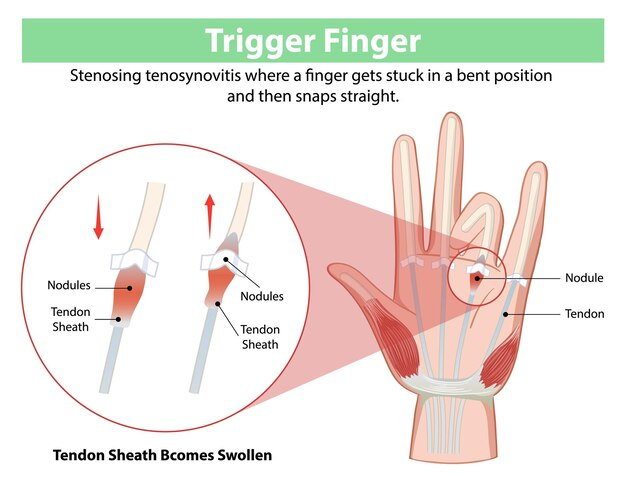
Trigger finger is a condition in which inflammation or thickening develops in the tendon that bends the finger.
As a result, the tendon does not glide smoothly through its sheath.
Patients often notice:
- A catching or locking sensation when bending or straightening the finger
- A clicking or snapping sound
- Difficulty fully extending the finger
Pain is most commonly felt at the base of the finger on the palm side,
near the joint where the finger meets the hand.
In some cases, tenderness or a small lump can be felt in this area.
Symptoms may range from mild stiffness to a finger that becomes stuck in a bent position.
Why Does Surgery Even Come Up?
Trigger finger develops when the tunnel through which the tendon moves becomes narrowed.
Early on, symptoms may be subtle and intermittent.
However, with repeated inflammation:
- The tendon may thicken further
- The locking sensation becomes more noticeable
- Daily hand use becomes increasingly uncomfortable
When symptoms persist despite rest, medication, or injections,
surgery may be discussed as a treatment option.
When Can Trigger Finger Improve Without Surgery?
Many cases improve without surgery, especially when addressed early.
Non-surgical treatment may be effective if:
- Symptoms began recently
- Locking occurs only occasionally
- Pain is mild and daily activities are still manageable
- Conservative treatments provide relief
Reducing repetitive hand use, taking anti-inflammatory medication, or receiving an injection
often leads to meaningful improvement.
When Should Surgery Be Considered?
Surgery may be considered in the following situations:
- Symptoms persist for several months
- Triggering continues despite injection treatment
- The finger frequently locks or cannot be straightened
- Pain significantly interferes with daily life
Trigger finger surgery involves releasing the tightened portion of the tendon sheath.
It is generally a short procedure and is often performed under local anesthesia.
Is Trigger Finger Surgery Dangerous?
Hearing the word “surgery” can feel intimidating.
Fortunately, trigger finger surgery typically has a quick recovery and a high success rate.
That said, as with any procedure, potential risks—such as nerve or blood vessel injury—do exist, though they are uncommon.
For this reason, proper evaluation and discussion with a specialist are essential.
Doctors consider:
- The severity of symptoms
- Response to conservative treatment
before recommending surgery.
When Should You See a Doctor?
You should consider seeing a specialist if:
- Finger locking becomes more frequent or severe
- Pain persists over time
- Symptoms do not improve with medication or rest
- Hand function is noticeably affected
Early diagnosis and conservative treatment often increase the chance of avoiding surgery.
In Summary
Trigger finger does not always require surgery.
Many patients improve with non-surgical treatment, especially when symptoms are addressed early.
However, if symptoms persist or worsen despite conservative care,
surgery can be an effective and appropriate option.
Rather than trying to decide on your own,
it’s best to have your condition evaluated by an orthopedic specialist.
This ensures that treatment is tailored to your specific symptoms and stage of the condition.
If you’re experiencing other hand or wrist symptoms—such as pain, stiffness, or numbness—it may help to look at the bigger picture.
You can find a comprehensive overview of related conditions in our guide,
Hand and Wrist Pain: Common Causes and When You Should See a Doctor.
Leave a Reply