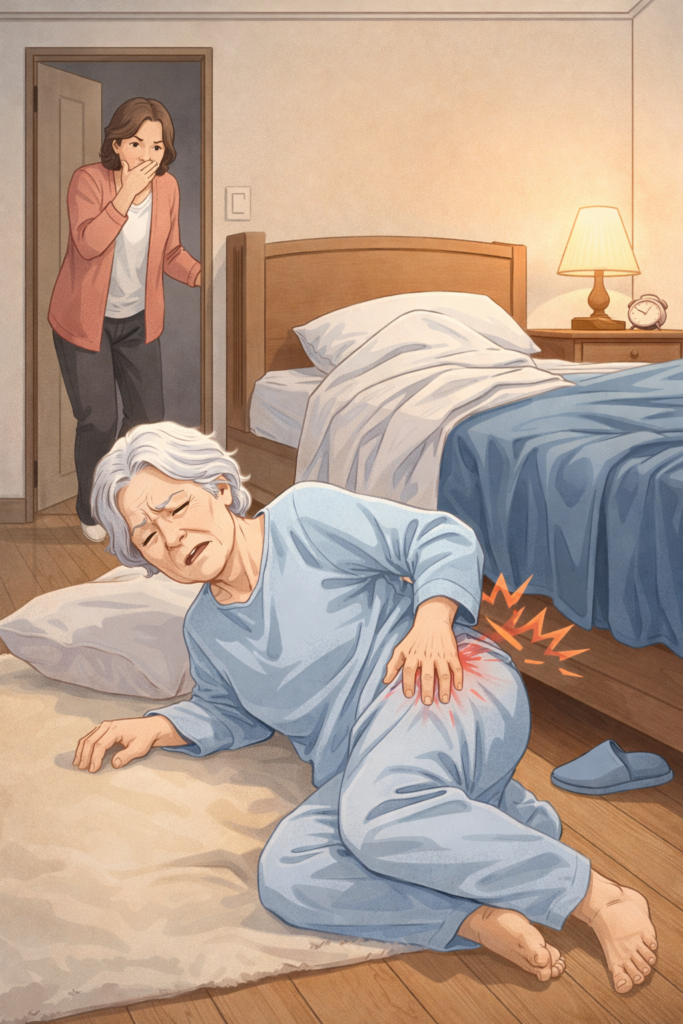
Hip fractures in older adults often occur unexpectedly.
In clinical practice, one of the most common situations we see is an elderly patient who fell from bed during sleep.
In other cases, the fracture happens after a minor slip while walking at home or bumping lightly into furniture.
When family members arrive at the emergency room, they often say similar things:
“Will she ever be able to walk again?”
“I heard hip fracture surgery is very dangerous… I’m really worried.”
“She didn’t fall hard at all — how could this cause a fracture?”
In younger individuals, hip fractures usually occur only after high-energy trauma, such as car accidents.
However, in older adults, osteoporosis is very common.
Because the bone is already weakened, even a minor fall can result in a fracture.
This is why hip fractures are often shocking and difficult for families to accept.
In this article, I will explain — step by step —
what families should know after a hip fracture diagnosis, and how to approach treatment calmly and safely.
Why is a hip fracture so serious in older adults?
The hip joint plays a critical role in supporting body weight and allowing walking.
When a fracture occurs in this area, the problem is not simply “a broken bone.”
It often leads to:
- Difficulty walking independently
- Prolonged bed rest
- Decline in overall physical function
For this reason, hip fractures in elderly patients require careful and timely treatment decisions.
Does hip fracture always require surgery?
This is the question families ask most often.
Many people have heard statements like:
- “Hip surgery is very risky.”
- “Elderly patients don’t survive major surgery.”
These concerns are understandable — especially in patients with heart disease, lung disease, or kidney problems.
It is true that hip fracture surgery involves more blood loss and physiological stress than many other orthopedic procedures.
However, most hip fractures in older adults are best treated surgically.
The reason is simple.
The hip is a weight-bearing joint.
Immobilization with a cast or brace is usually not feasible.
Even if non-surgical treatment were attempted, the patient would need to remain in bed for 10–12 weeks or longer.
During prolonged bed rest, the risk of serious complications rises rapidly, including:
- Pneumonia
- Pressure ulcers
- Muscle wasting
- Delirium
In many cases, these complications pose a greater danger than the surgery itself.
For this reason, early surgical stabilization — allowing the patient to move again — often leads to better overall outcomes, even in high-risk patients.
That said, treatment is never “one-size-fits-all.”
The surgical plan depends on:
- Fracture location and pattern
- Patient age
- Pre-injury walking ability
- Overall medical condition
Should surgery be done immediately?
Whenever possible, early surgery is recommended.
In elderly patients, even 3–4 days of bed rest can significantly increase the risk of:
- Pneumonia
- Blood clots
- Muscle weakness
- Functional decline
Of course, if the patient has serious underlying medical conditions, a full medical evaluation is performed first.
Heart, lung, and kidney function are carefully assessed, medications are adjusted, and the anesthesia team is involved.
This process is not meant to delay treatment unnecessarily —
it is done to determine the safest possible timing for surgery.
Will she be able to walk again after surgery?
This is often the most frightening question for families.
The most important factor is how well the patient was walking before the injury.
To estimate walking ability, physicians commonly use the Koval grading system, which evaluates functional mobility.
Although Koval grade includes seven levels, in daily clinical practice, the most important distinction is whether the patient:
- Walked independently
- Required a cane
- Used a walker
Simplified examples include:
- Grade 1: Independent walking without aids
- Grade 2: Walking with a cane
- Grade 3: Walking with a walker
- Grade 4 or higher: Limited indoor walking or wheelchair use
After hip fracture surgery, many patients experience a decline of about 1–2 Koval grades.
For example:
- Independent walkers may require a cane or walker
- Cane users may require a walker
This is very common and should not be viewed as failure.
However, patients who:
- Participate actively in rehabilitation
- Maintain motivation
- Receive strong family support
can sometimes return to a level close to their pre-injury walking ability.
In my experience, the patient’s will and the family’s involvement are just as important as the surgery itself.
A message for family members
Hip fracture is not only a physical injury —
it is also an emotional shock for families.
Many caregivers think:
“If only I had been more careful…”
But in older adults, hip fractures can occur even with minimal trauma, despite the best precautions.
This is not anyone’s fault.
What matters most now is:
- Consistent rehabilitation
- Creating a safer home environment to prevent future falls
Taking these steps can make a meaningful difference in recovery.
In summary
- Hip fracture is a serious injury in older adults.
- Surgical treatment is required in most cases.
- Early treatment and active rehabilitation strongly influence recovery.
Even in an unexpected and frightening situation,
working closely with an orthopedic specialist and moving step by step can help guide the patient toward the best possible outcome.
Leave a Reply