After getting an X-ray or MRI, many patients hear this sentence:
“Your knee cartilage is worn down.”
And almost immediately, a few worries follow:
- “Does this mean I need surgery?”
- “Am I going to have trouble walking in the future?”
This is one of the most common questions orthopedic doctors hear in daily practice.
Let me start with an important message:
Having worn knee cartilage does NOT automatically mean you need knee replacement surgery.
In fact, many patients who are told their cartilage is “worn”
do not need surgery right away.
What Does “Worn Knee Cartilage” Actually Mean?
Inside the knee joint, cartilage acts as a cushion between the bones,
preventing direct friction during movement.
Over time, cartilage can gradually change due to:
- Aging
- Repetitive knee use
- Excess body weight
- Previous injuries
When doctors say “the cartilage is worn,” it often means:
- The cartilage has become thinner
- The surface looks irregular
- Early degenerative changes are visible
✅ In most cases, this does not mean the cartilage is completely gone.
On imaging studies such as X-ray or MRI,
“cartilage wear” usually indicates early or partial degeneration, not end-stage arthritis.
When Surgery Is Usually NOT Necessary
In many patients, surgery is not needed if:
- Pain is not constant
- Symptoms improve with rest
- Daily activities are still possible
- Pain improved previously with medication or injections
In these situations, symptoms can often be managed with:
✅ Conservative (non-surgical) treatment
including lifestyle modification, medication, and injection therapy.
When Should Surgery Be Considered?
On the other hand, surgery may be considered if:
- Pain is severe enough to disturb sleep
- Walking or climbing stairs becomes extremely difficult
- Recurrent knee swelling occurs
- Conservative treatment has been tried adequately without improvement
- Symptoms return quickly after injections (for example, pain returns within 1–2 weeks)
- Knee deformity continues to progress
It is important to understand that total knee replacement is considered a last-stage treatment,
reserved for cases where pain and functional limitation significantly interfere with daily life.
Imaging Alone Does Not Determine Surgery
One common misunderstanding is believing that surgery is decided solely based on MRI or X-ray findings.
In reality: Imaging results alone do not determine the need for surgery.
What matters most is:
- How severe your symptoms are
- How much your daily life is affected
- Whether pain improves with conservative treatment
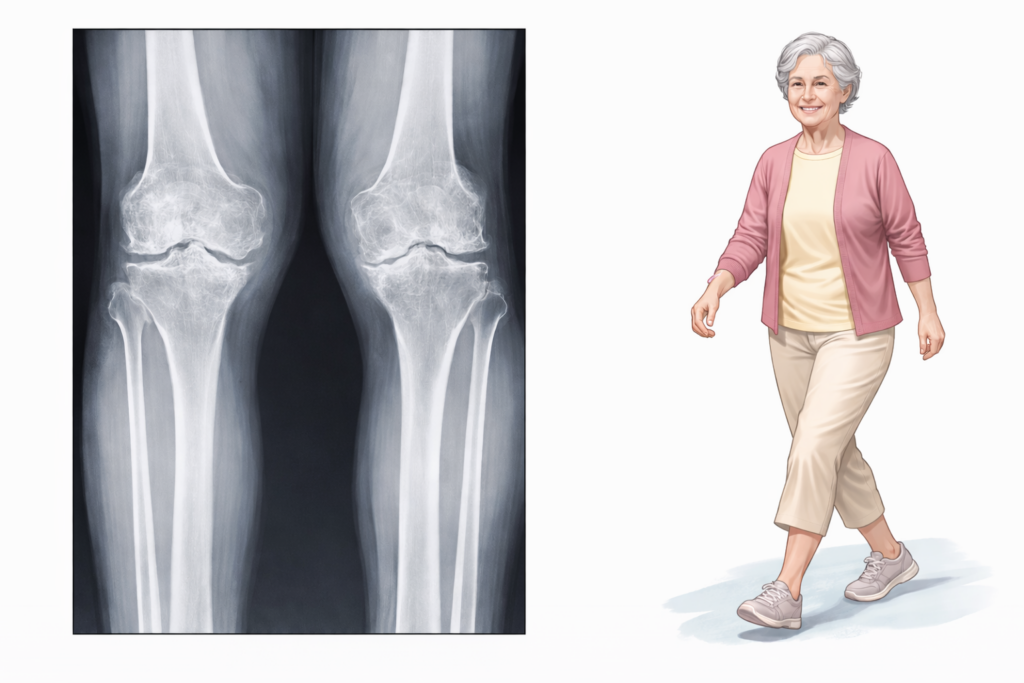
Some patients show severe arthritis on X-ray
but experience only mild symptoms and function well without surgery.
What You Can Do Starting Now
Even if cartilage wear is present, there are many things patients can actively do:
- Weight control to reduce stress on the knee
- Low-impact exercise, such as swimming (often the first exercise recommended in orthopedic clinics)
- Quadriceps strengthening exercises — even simple muscle tightening while sitting can be effective, especially for older adults
Importantly, completely avoiding movement is not recommended.
The key is choosing activities that minimize stress on the knee
Cartilage wear is only one possible cause of knee pain.
For a broader overview of different knee conditions — and how doctors determine the real source of pain — you may find this guide helpful:
👉 My Knee Hurts — What Could Be the Problem?.
A Final message from the clinic
Being told that your knee cartilage is worn down
does not automatically mean surgery is inevitable.
Even when imaging shows advanced arthritis:
- If pain is manageable
- If daily function is preserved
- If conservative treatments are effective
surgery may not be necessary at this time.
The most important factor is not the image —
but your symptoms and how they affect your life.
Leave a Reply