Will Frequent Injections Weaken the Tendon?
When patients visit an orthopedic clinic for shoulder pain,
they are often advised to consider injection therapy.
At that point, many people ask similar questions:
“Can injections damage my tendon?”
“I heard steroid shots can weaken the shoulder.”
“Is it safe to get injections repeatedly?”
These concerns are very common.
To begin with an important point:
✔ Shoulder injections are not inherently harmful — what matters is how and how often they are used.
Not All Shoulder Injections Are the Same
The term “shoulder injection” is often used broadly,
but several different medications may be involved.
Common medications include:
- Local anesthetics
- Corticosteroids (anti-inflammatory medication)
Among these, corticosteroid injections are the most commonly used — and the most misunderstood.
Do Steroid Injections Really Weaken Tendons?
The most accurate answer is: they can, under certain conditions.
Problems may occur when:
- Injections are given repeatedly within a short period of time (for example, several injections within one month)
- Injections are performed without a clear diagnosis
- Medication is accidentally injected directly into the tendon
When these situations are repeated, the risk of:
✔ tendon weakening
✔ increased risk of rotator cuff injury
may increase.
Why an Accurate Diagnosis Comes First
Before deciding on injection therapy,
understanding the exact cause of shoulder pain is essential.
- Ultrasound examination can help evaluate:
- tendon inflammation
- partial tears
- calcific deposits
- MRI may be helpful when pain persists or a rotator cuff tear is suspected, allowing more detailed assessment of tendon integrity.
These evaluations help determine:
- whether an injection is truly necessary
- where the medication should be delivered
- how to perform the injection safely
When Are Shoulder Injections Generally Considered Safe?
Injection therapy is typically safer when:
- it is performed only when clearly indicated
- adequate time intervals are maintained between injections (commonly about once every 6 months; shorter intervals may be considered only in severe cases)
- injections are performed under ultrasound guidance
- the goal is short-term pain and inflammation control, not long-term dependence
In these situations, injections can serve as a tool to:
✔ reduce pain
✔ allow rehabilitation and exercise
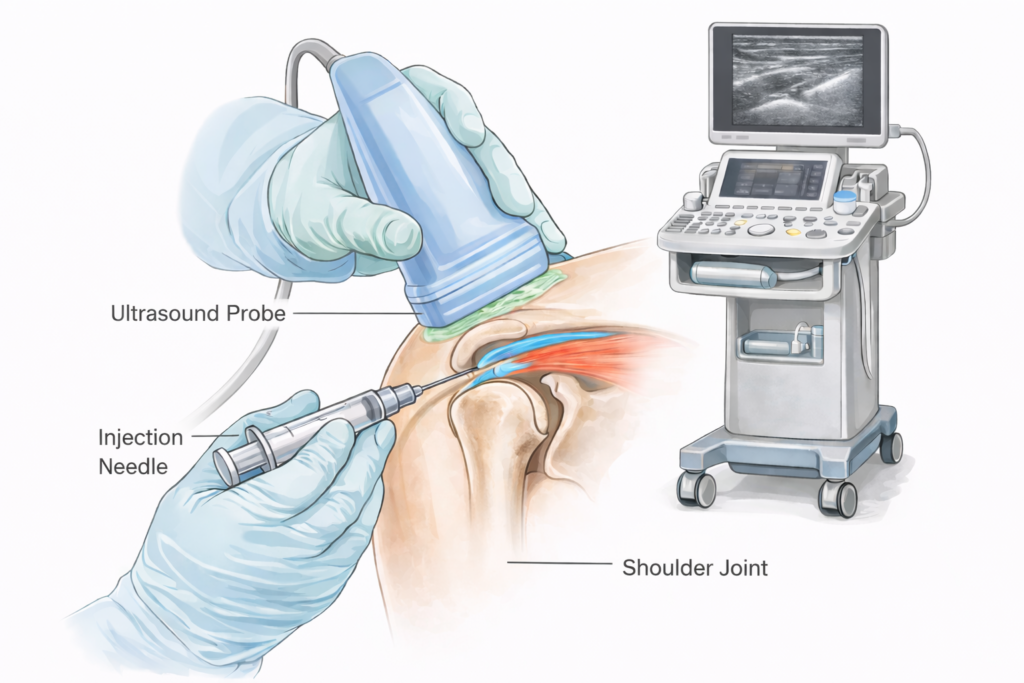
Why Ultrasound-Guided Injection Matters
Using ultrasound allows the physician to:
- confirm that the needle is not entering the tendon itself
- target the inflamed area precisely
As a result:
✔ unnecessary repeat injections can be avoided
✔ complication risk can be reduced
How Often Is “Too Often”?
This is one of the most common questions patients ask.
In general:
- more than 3–4 injections per year in the same area should be approached with caution.
However, the appropriate number may vary depending on:
- the underlying diagnosis
- injection location
- patient age and tendon condition
Why Injections Alone Are Not Enough
Injection therapy:
✔ does not correct the underlying cause
✔ primarily controls pain and inflammation
For long-term improvement, injections should be combined with:
- stretching
- rehabilitation exercises
- posture and activity modification
A final message from the clinic
✔ Shoulder injections are not automatically harmful
✔ Risk depends on diagnosis, frequency, and technique
✔ Ultrasound guidance improves safety
✔ Injections are a starting point, not the final treatment
If shoulder pain persists,
the most important step is not simply deciding whether to get another injection —
but identifying why the pain is occurring in the first place.
Injections are one part of shoulder pain management,
but they are not appropriate for every condition.
For a full overview of common causes of shoulder pain
and how treatment decisions are made,
see our overview of shoulder pain.
Leave a Reply